
Projection Mapping: What It Is and How It Works
Projection mapping adapts a digital image to real architecture. Learn how projectors, geometry, masks and light become a precise extension of a building.
What is projection mapping?
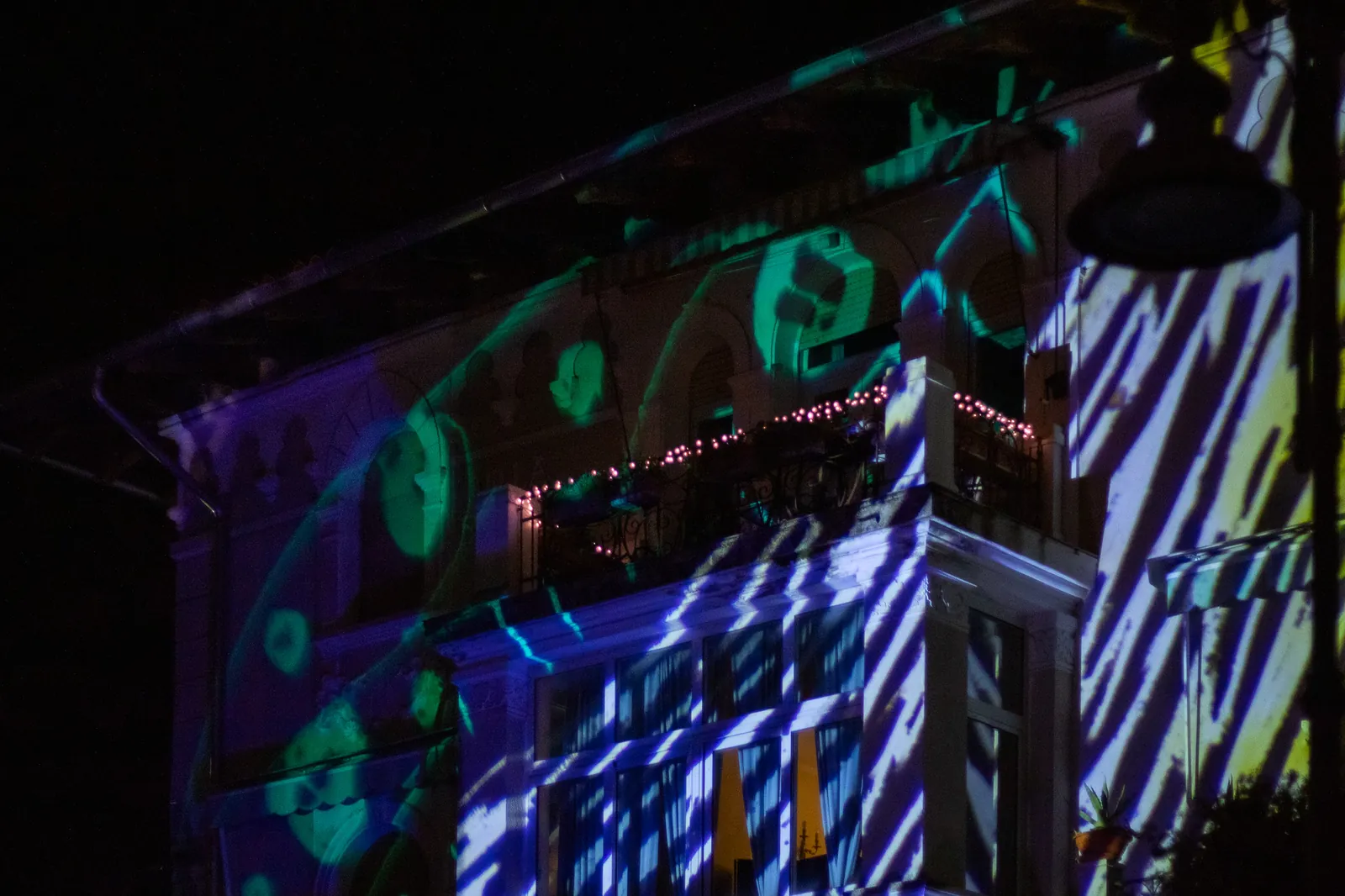
Projection mapping is the process of adapting a digital image to a physical surface and to its geometry. Instead of showing content on a flat screen, the image is mapped to real edges, openings, angles and depths.
The basic principle is simple: a projector provides light, while the digital content decides where and how that light appears. When calibration is accurate, a window can become part of a scene and a façade can gain a new dimension without touching the building.
How does a projection take the shape of a building?
The content is first prepared as a map or mask that covers only the intended area. It is then warped to the projector perspective, while the mask defines the edges of the projected image.
With multiple projectors, the images overlap, join and blend. A carefully chosen overlap ratio creates wide, almost invisible transitions between projections.
Why do calibration and testing matter?
Projection mapping is not only precise software display. Outdoors, projector position, distance, angle, surface brightness, ambient light, stone texture and safety margins all matter.
A good test does not involve only a screen. Watch the content from different distances, in changing weather and from the angles visitors will actually use. The best map is always refined on site.
Where is projection mapping used?
The technique is used on buildings, museum exhibitions, festivals, stage designs and public installations. It is especially powerful when architecture already has a strong story: columns, windows, arches and textures can become part of the content.
Projection mapping does not replace architecture. It adds a dynamic layer that can be subtle, informative, narrative or completely abstract.